

About HART
In the 1980s, Rosemount developed the first HART (Highway Addressable Remote Transducer). In 1989, the HART standard was introduced by the HART Communication Foundation (HCF), and it has been part of the IEC 61158 fieldbus standard since 2007.
The HART fieldbus is a fieldbus standard that is now primarily geared toward the requirements of the process industry. HART defines the communication protocol between multiple intelligent digital field devices (participants) and a control system (data bus). It is based on conventional 4–20 mA analog data technology. This allows existing wiring from older systems to continue to be used.
How HART Works
Using the Bell 202 FSK (Frequency Shift Keying) standard, a digital signal is superimposed on the 4–20 mA data transmission.
The low-frequency analog signal is superimposed with a high-frequency oscillation (+/- 0.5 mA). A digital 1 is represented by a frequency of 1.2 kHz and a 0 by 2.2 kHz. Data transmission over the HART bus is 1.2 kbit/s.
This superimposition enables two-way communication with the field. This serves to obtain additional data.
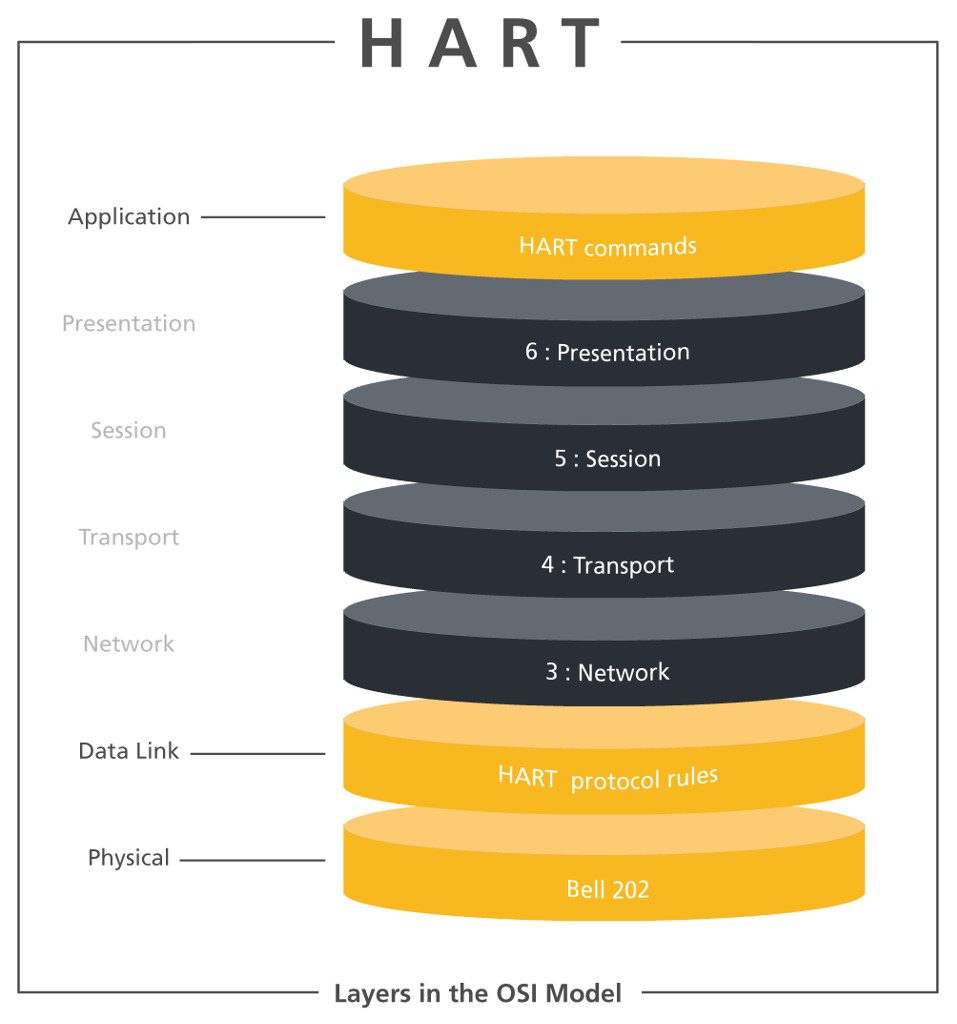
HART specifies protocol layers 1 (Physical Layer), 2 (Data Link Layer), and 7 (Application Layer) in the OSI model and allows the transmission of process and diagnostic information as well as control signals between field devices and the control system.
Device communication is handled via a master/slave protocol. This means that the slave (the intelligent field device) only sends information to the master (the host) when requested to do so.
Furthermore, an additional second master can be integrated, such as a mobile device. This does not interfere with data transfer between the slave and the primary master.
Advantages of HART
- Simultaneous operation of existing, older, and analog 4–20 mA systems alongside new digital systems
- Mobile test devices, calibration devices, and laptops for quick and easy analysis of field devices
- Easy handling of field device functional testing, diagnostics, and calibration
- Increased plant availability through early detection of fault signals
- Reduced maintenance costs through rapid remote diagnostics
Additional Technologies
WirelessHART
WirelessHART provides access to previously unused data from field devices. This enables the acquisition of new measurement parameters—all without any wiring.
The new standard was first introduced in 2007 and published by the HCF. To prevent interference while still ensuring safety, WirelessHART offers a wide range of features.
The radio transmission complies with the IEEE 802.14.4-2006 standard, which prevents interference through channel hopping. Data encryption according to 128-bit AES industry standards is also provided to ensure that data transfer and the configuration of field devices cannot be altered without authorization.
HART-IP
HART-IP technology enables access to data via Ethernet. This allows for remote access to devices from anywhere in the world, as well as intelligent device management via Ethernet or Wi-Fi.
Thorsis Technologies offers a comprehensive range of communication solutions for integrating HART into the process and automation industries.
Thorsis HART Gateways
HART
About HART In the 1980s, Rosemount developed the first HART (Highway Addressable Remote Transducer). In 1989, the HART standard was introduced by the HART Communication Foundation (HCF), and it has been [...]
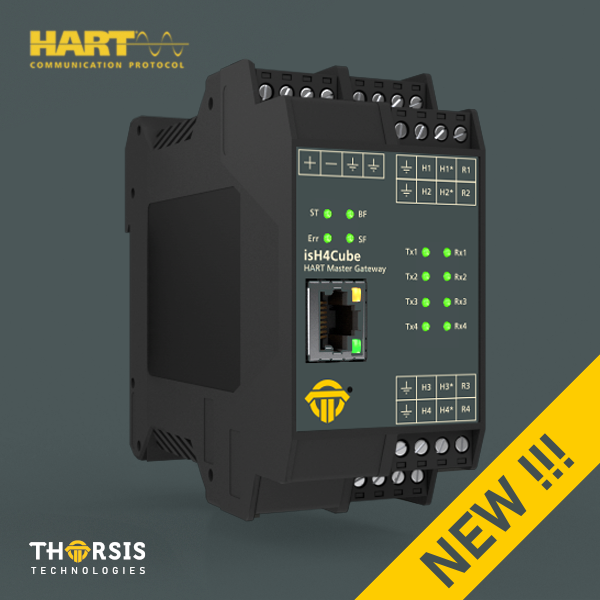
isH4Cube
HART-Master Gateway The isH4Cube is an Ethernet gateway for the connection of HART instruments to an Ethernet network. The gateway translates from wired HART into a [...]
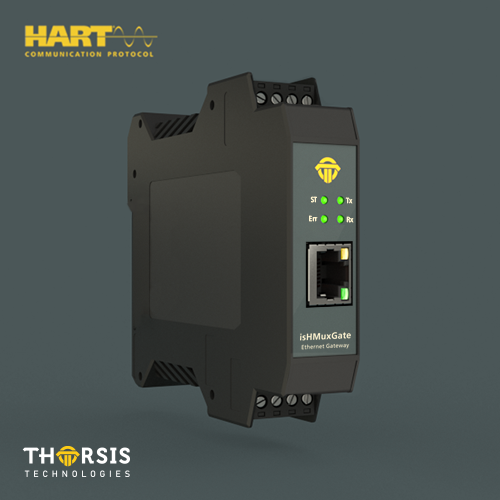
isHMuxGate
HART-IP Gateway The HART-IP gateway isHMuxGate is an ideal solution for retrofitting HART networks with Ethernet. It makes this possible without the need to replace existing RS485 [...]
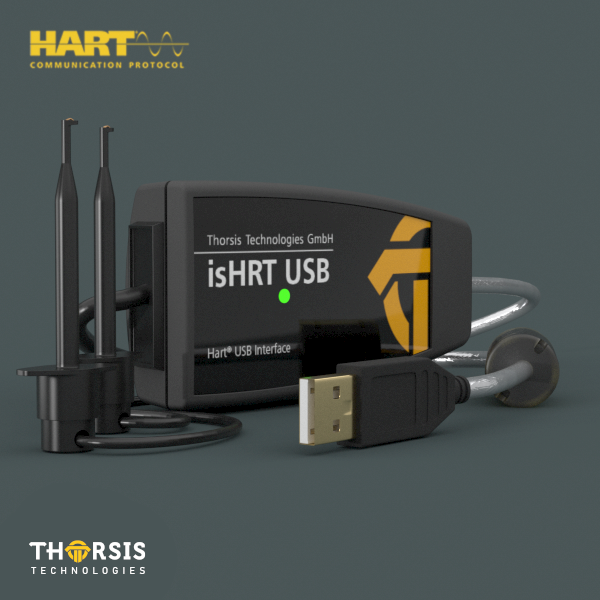
isHRT USB
HART USB Interface with Galvanic Decoupling The HART USB interface isHRT USB is designed to provide a communication link between a desktop computer or PC [...]
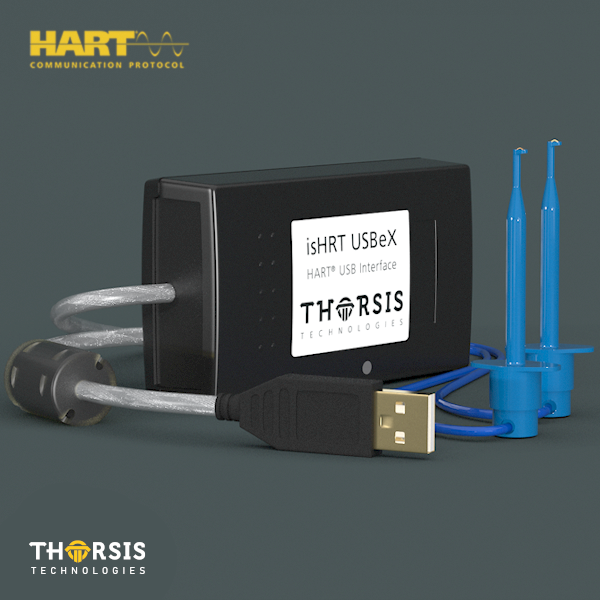
isHRT USBeX
ATEX certified HART USB Interface For use in hazardous areas we provide an intrinsically safe, ATEX certified HART USB interface. The interface may be attached to HART loops for [...]
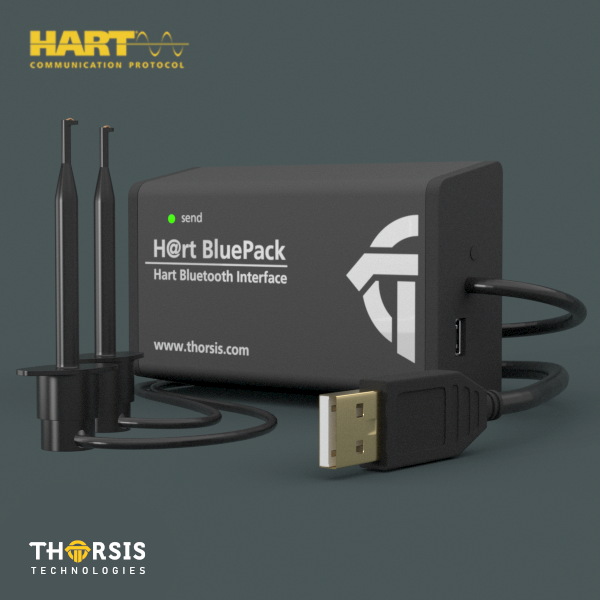
the H@rt BluePack
HART Bluetooth Interface The H@rt BluePack is a versatile interface which supports wireless (Bluetooth) and wired (USB) access to a HART network. In addition to its modem capabilities the H@rt Blue- Pack [...]
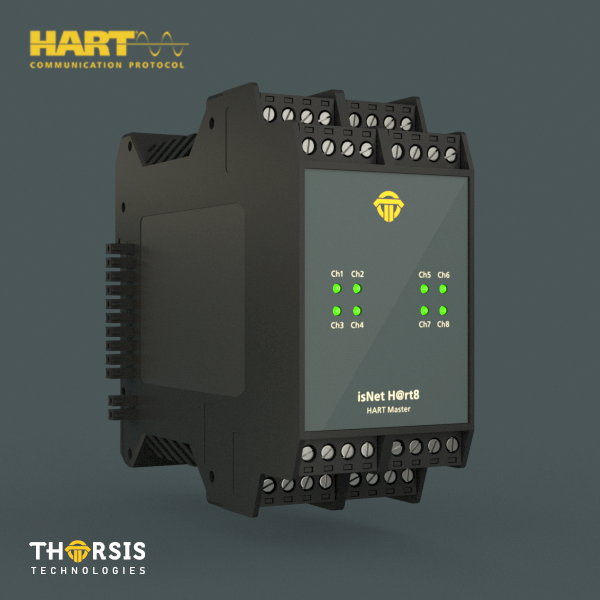
isNet H@rt4 / isNet H@rt8
HART Ethernet Gateway The isNet H@rt Module extends the main module isNet Lite to work as an HART-Ethernet gateway. The HART Ethernet gateway is an up-to-date option [...]
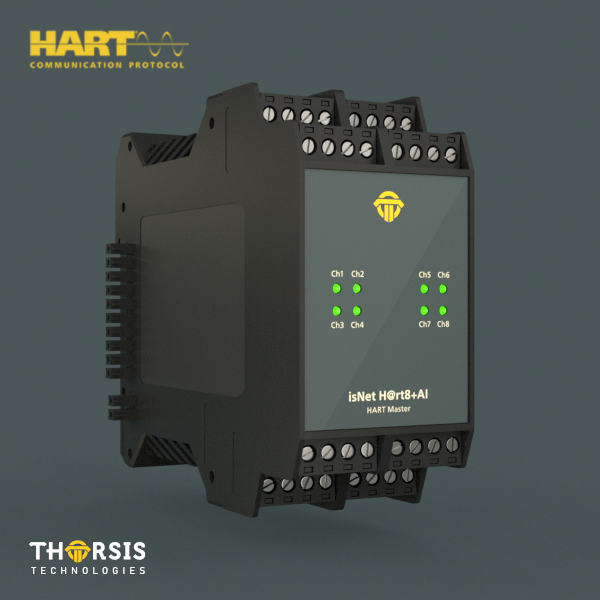
isNet H@rt8+AI
HART Analog Input Module 4-20mA and HART Master Functionality The HART module isNet H@rt8+AI contains 8 independent HART masters, every HART master with a separate HART modem, similar to the [...]
Thorsis HART USB Adapter

PROFIBUS
About PROFIBUS PROFIBUS (Process Field Bus) was originally a standard developed by Siemens for fieldbus communication in automation technology. In 1987, a consortium of over 20 institutions and companies was formed [...]
HART
About HART In the 1980s, Rosemount developed the first HART (Highway Addressable Remote Transducer). In 1989, the HART standard was introduced by the HART Communication Foundation (HCF), and it has been [...]

CAN
About CAN The CAN bus (Controller Area Network) is an asynchronous, serial fieldbus system. In 1983, Bosch developed the CAN bus for networking control units in automobiles. The goal of this [...]

DeviceNet
About DeviceNet The DeviceNet fieldbus is based on the CAN (Controller Area Network) protocol. Designed as a cost-effective yet powerful bus system for the lowest fieldbus level, it enables the networking [...]

FOUNDATION Fieldbus
About FOUNDATION Fieldbus FOUNDATION Fieldbus is a digital, bidirectional fieldbus designed to meet the requirements of process automation. This fieldbus is developed and maintained by the Fieldbus Foundation. As a member [...]

PROFINET
About PROFINET PROFINET (Process Field Network) is an Industrial Ethernet standard based on TCP/IP. PROFINET extends PROFIBUS technology with Ethernet functionality. PROFINET is divided into PROFINET CBA and PROFINET IO. PROFINET [...]
isH4Cube
HART-Master Gateway The isH4Cube is an Ethernet gateway for the connection of HART instruments to an Ethernet network. The gateway translates from wired HART into a [...]
isHMuxGate
HART-IP Gateway The HART-IP gateway isHMuxGate is an ideal solution for retrofitting HART networks with Ethernet. It makes this possible without the need to replace existing RS485 [...]

PlantaPress – smart Foot Pressure Measurement
Medical foot pressure measurement system for gait and load analysis Connection schema Description PlantaPress is a tool designed for recording static and dynamic pressure [...]
ThorTraffic
ThorTraffic enables data exchange via ITS-G5 with passing vehicles ThorTraffic enables data exchange via ITS-G5 with passing vehicles through resource-efficient reuse [...]

Pro Multi Server
Driver software Windows 7, Windows 8, Windows 10 English documentation on CD Support and maintenance contract for 1 year Features/supported protocols Support from OPC according to specification version 2.04 DP master cl. 1,2, [...]
Pro Comm DTM
Driver software Windows 7, Windows 8, Windows 10 FDT Frame e.g. Pactware Features / supported protocols PROFIBUS DPV1 PROFIBUS PA Scope of delivery CD The Pro Comm DTM is a [...]
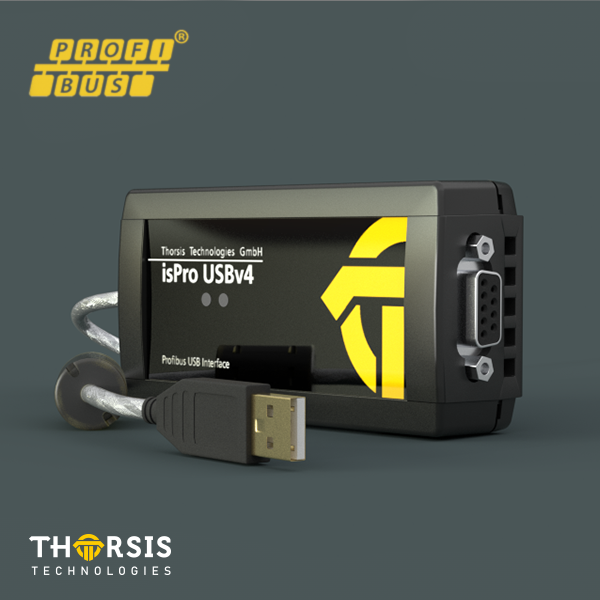
isPro USBv4
PROFIBUS USB Interface with Converter for PROFIBUS PA-Networks The isPro USBv4 is the successor of isPro USBx12. It is compatible with the isPro USBx12. [...]

Kepware OPC Server
The Kepware OPC Server KEPServerEX is a powerful industrial connectivity platform with drivers for more than 160 different controllers. The server is thus a central data source for industrial automation, OPC-UA applications [...]

Test Laboratory
Registration and Certification Take advantage of the versatile possibilities of using the device description in order to underline the attractiveness of your products. We would be pleased to provide you the best [...]
isHRT USB
HART USB Interface with Galvanic Decoupling The HART USB interface isHRT USB is designed to provide a communication link between a desktop computer or PC [...]
isHRT USBeX
ATEX certified HART USB Interface For use in hazardous areas we provide an intrinsically safe, ATEX certified HART USB interface. The interface may be attached to HART loops for [...]
the H@rt BluePack
HART Bluetooth Interface The H@rt BluePack is a versatile interface which supports wireless (Bluetooth) and wired (USB) access to a HART network. In addition to its modem capabilities the H@rt Blue- Pack [...]
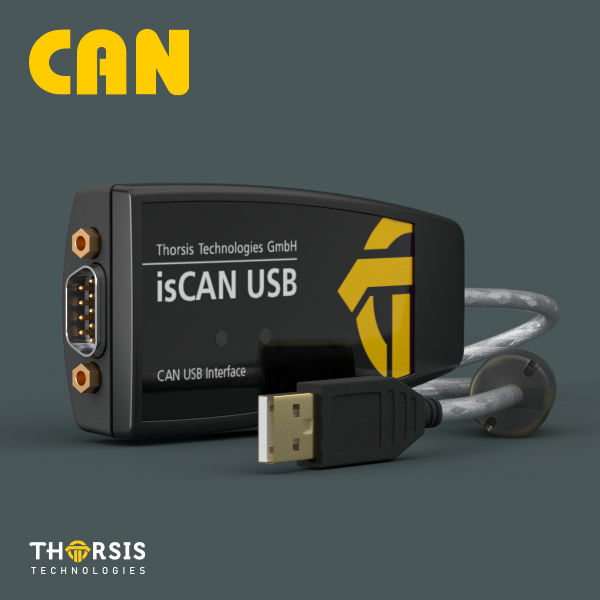
isCAN USB
CAN USB Interface for CAN/CANopen Networks 209,50 € plus VAT and shipping costs The CAN dongle isCAN USB with the USB interface grants a fast access to [...]
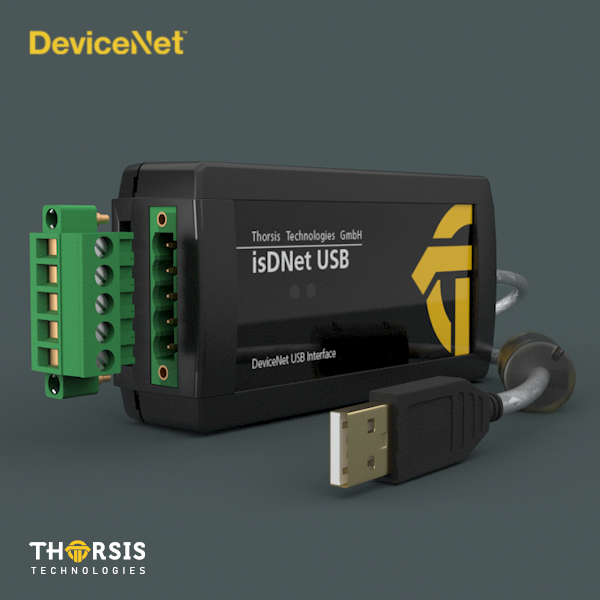
isDNet USB
DeviceNet USB Interface The Interface isDNet USB provides a communication link between a desktop computer or PC notebook and a Device Network. Real-time data of the field [...]
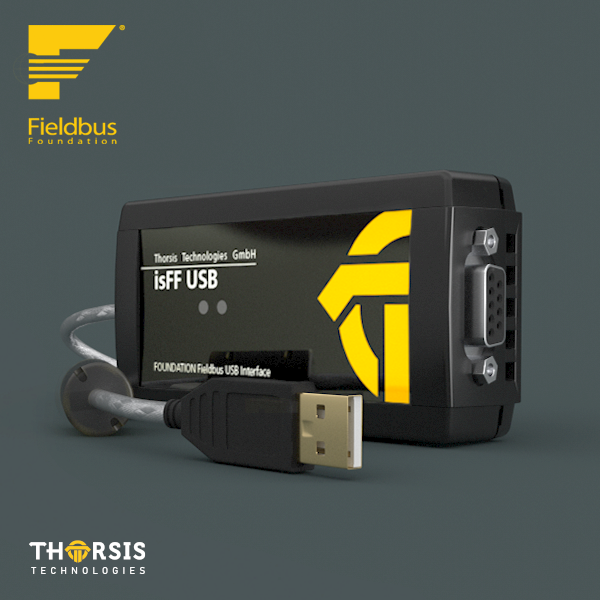
isFF USB
FOUNDATION Fieldbus USB interface The isFF USB Interface is a FOUNDATION Fieldbus USB interface, that is made for rapid commissioning of FOUNDATION Fieldbus devices. Due to power supply from USB and plug-and-play functionality, [...]
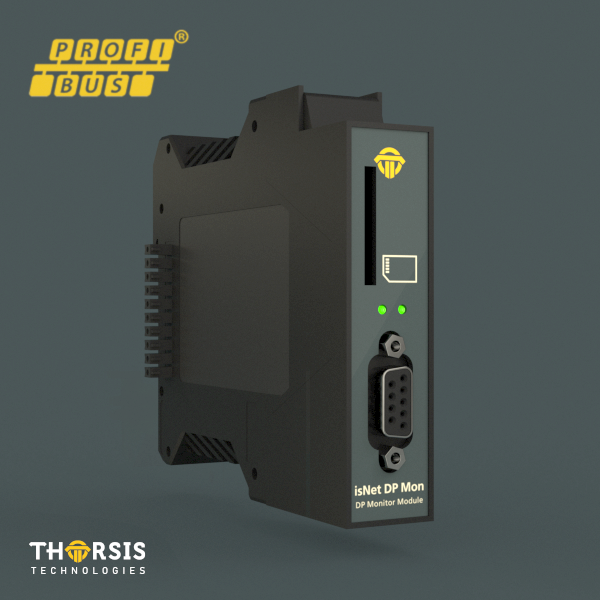
isNet DPMon
PROFIBUS DP Diagnosis and Monitoring Module With the isNet DPMon module any gateway built with the isNet Lite can be extended to operate as a PROFIBUS DP diagnosis and protocol [...]
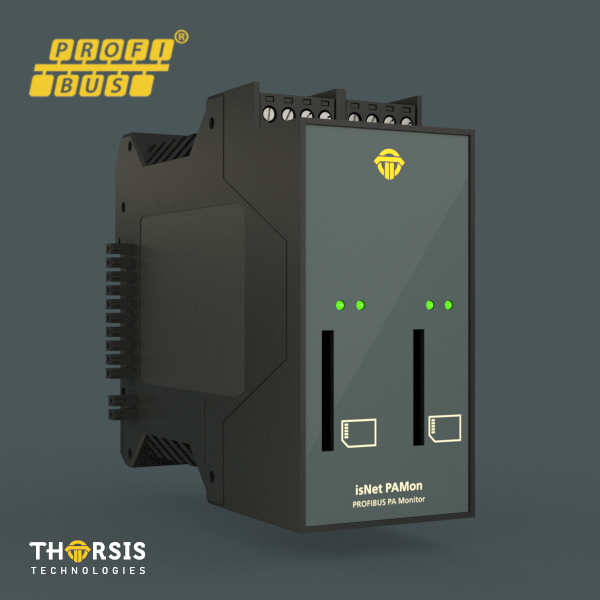
isNet PAMon
PROFIBUS PA Diagnosis and Monitor Module With the isNet PAMon module, any gateway built with the isNet Lite can be extended to operate as a PROFIBUS PA diagnosis and protocol [...]
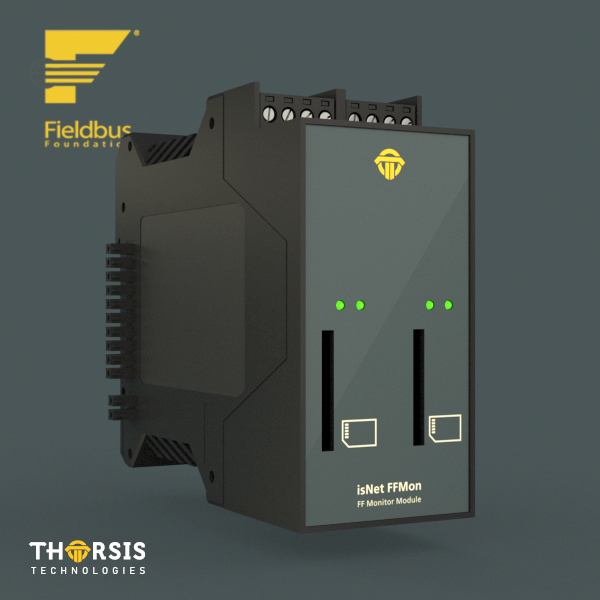
isNet FFMon
FOUNDATION Fieldbus Diagnosis and Monitoring Module The isNet FFMon module extends the Ethernet module isNet Lite to operate as a diagnosis and protocol monitor for FOUNDATION Fieldbus. The module helps [...]

Hardware Development
Development of customer specific hardware As a supplier for customized communication solutions we offer hardware solutions specially tailored to your needs. This may be the adaptation of our products in [...]