

About DeviceNet

The DeviceNet fieldbus is based on the CAN (Controller Area Network) protocol. Designed as a cost-effective yet powerful bus system for the lowest fieldbus level, it enables the networking of sensors, actuators, and associated controllers. Its primary application is factory automation.
About DeviceNet
DeviceNet was originally developed by Allen-Bradley, a division of Rockwell Automation, and later transferred to the ODVA (Open DeviceNet Vendor Association) for marketing as an open fieldbus standard. Today, it is standardized according to the European standard EN 50325.
ControlNet and Ethernet/IP, together with DeviceNet, belong to the CIP (Common Industrial Protocol) networks. ControlNet represents the cell level, Ethernet/IP the control level, and DeviceNet the field level.
According to the producer-consumer model, the DeviceNet device can be the client (master) or the server (slave). The clients and the server, in turn, can be producers, consumers, or both.
DeviceNet Technology
A unique address is assigned to a maximum of 64 network nodes per segment. The addresses of the network nodes (0 to 63) can be set using rotary or DIP switches.
The transmission speed is either 125 kbaud, 250 kbaud, or 500 kbaud. The baud rates can also be set using a rotary or DIP switch.
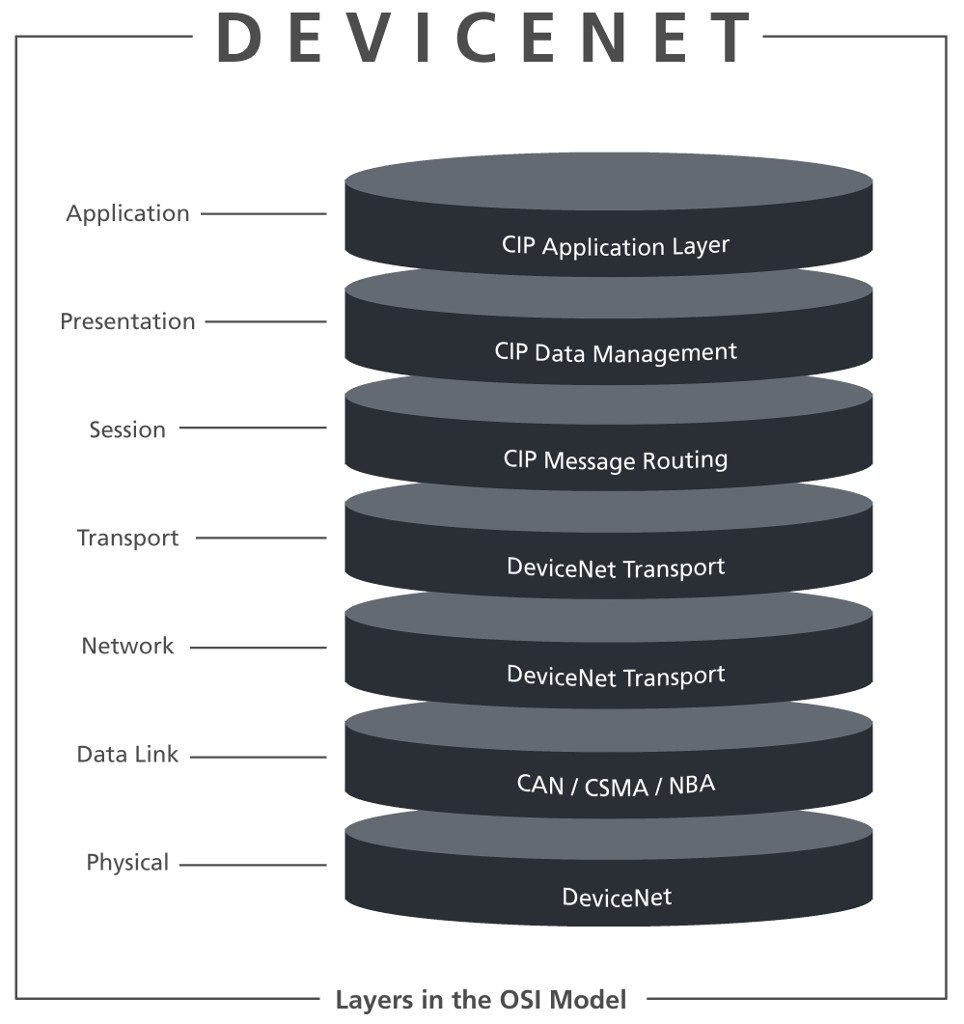
The open network standard DeviceNet uses the CAN specifications of the OSI model on the lower layers (1–4). CAN is characterized in Layer 2 (Data Link Layer) by an interference-free method for avoiding collisions during simultaneous data transmission.
On the upper layers (5–7), it uses the Common Industrial Protocol defined by the ODVA. This layer enables the end-to-end connection of automation components from the field level to Ethernet. This makes the real-time data from field devices available for applications such as mobile data acquisition and parameterization.
Unsere DeviceNet USB Adapter
DeviceNet
About DeviceNet The DeviceNet fieldbus is based on the CAN (Controller Area Network) protocol. Designed as a cost-effective yet powerful bus system for the lowest fieldbus level, it enables the networking [...]
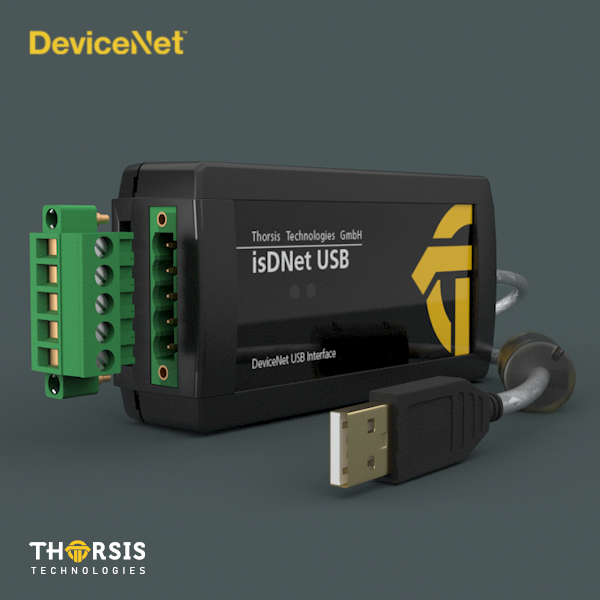
isDNet USB
DeviceNet USB Interface The Interface isDNet USB provides a communication link between a desktop computer or PC notebook and a Device Network. Real-time data of the field [...]